
Hearing Loss and Dementia Risk: What Research Actually Shows
Few health concerns weigh on people quite like dementia, especially for anyone who has watched a parent or grandparent live with it. So when headlines link hearing loss to dementia, it is natural to want a clear answer: how strong is the connection, and does doing something about your hearing make a difference?
At Cedar Ridge Hearing in Georgetown, brain health is central to how we approach hearing care. That also means being straightforward about what the research does and does not show. Here is where the evidence stands.

Is Hearing Loss Linked to Dementia?
Yes. Hearing loss is one of the most significant modifiable risk factors for dementia identified so far.
In 2024, the Lancet Commission on dementia prevention identified 14 risk factors that people can potentially change, and estimated that together they account for roughly 45% of dementia cases worldwide. Hearing loss was estimated to account for about 7% on its own, tied with high LDL cholesterol for the largest share of any single factor.
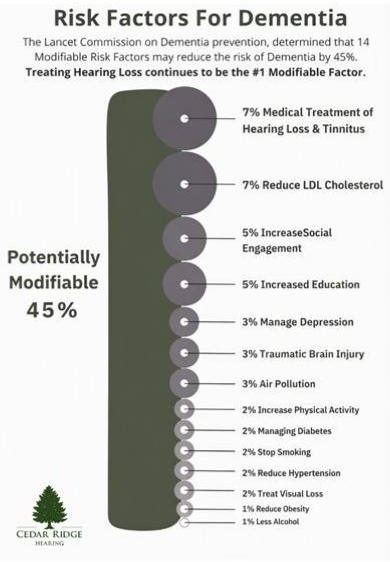
It is worth being clear about what "risk factor" means. A risk factor raises the likelihood of developing a condition. It doesn't mean someone with hearing loss will develop dementia, and many people with hearing loss never do.
Why Would Hearing Affect the Brain?
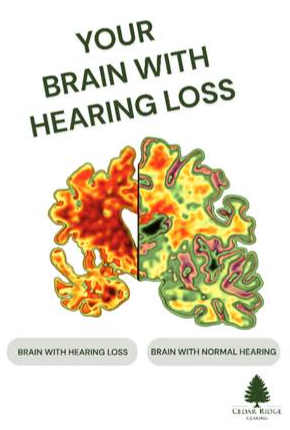
A direct cause hasn't been proven, but researchers have suggested a few explanations that may work together:
· Listening effort. When hearing declines, the brain has to work harder to make sense of speech, which may leave less capacity for memory and thinking.
· Reduced stimulation. Less sound reaching the brain means less activity in the pathways that process it.
· Social withdrawal. Conversations become tiring, so people gradually step back from social settings, and social isolation is itself a dementia risk factor.
Can Treating Hearing Loss Lower Dementia Risk?
The evidence is promising but not settled, and it is worth understanding what the largest study found.
The ACHIEVE trial, published in The Lancet in 2023, followed 977 adults aged 70 to 84 with untreated hearing loss over three years. Across the whole group, hearing treatment didn't significantly slow cognitive decline. However, among a subgroup of participants who were at higher risk of cognitive decline to begin with, hearing treatment slowed decline by 48%.
That is an encouraging result, and research is continuing. What it does not show is that hearing aids prevent dementia, and anyone who tells you otherwise is getting ahead of the evidence. What we can say with confidence is that treating hearing loss improves communication and connection, and supports the kind of active, social life that is good for brain health.
When Hearing Loss Looks Like Memory Loss
For families, there’s one practical point worth knowing: untreated hearing loss can be mistaken for cognitive decline. A parent who mishears a question may give an answer that seems off-topic, lose track of conversations, or seem withdrawn at family gatherings. Before assuming the worst, a hearing assessment is a sensible first step.
For people who want a broader picture of brain health, we also offer cognitive screening using the Cognivue Thrive screener, which takes about 10 minutes. A screening isn’t a diagnosis, but it can help show whether a follow-up conversation with your family doctor would be worthwhile. That can be especially reassuring if dementia runs in your family.
Frequently Asked Questions
Is hearing loss linked to dementia?
Yes. The 2024 Lancet Commission on dementia identified hearing loss as one of 14 modifiable risk factors and estimated it accounts for about 7% of dementia cases worldwide, tied for the largest share of any single factor. A risk factor raises the likelihood of developing dementia, but doesn’t mean someone with hearing loss will develop it.
Does hearing loss cause dementia?
The link is well established, but a direct cause has not been proven. Researchers have proposed several explanations, including the extra mental effort needed to follow speech, reduced stimulation to the brain's hearing pathways, and the social withdrawal that often comes with untreated hearing loss.
Can hearing aids prevent dementia?
There is no evidence that hearing aids prevent dementia. In the ACHIEVE trial, hearing treatment didn’t slow cognitive decline across the whole group of 977 older adults but it slowed decline by 48% over three years in a subgroup at higher risk. The findings are encouraging and research is ongoing.
Can hearing loss be mistaken for memory problems?
It can. Someone who mishears a question may give an answer that seems off-topic, miss parts of a conversation, or withdraw from group settings, which can look like confusion or memory decline. A hearing assessment is a sensible first step when a family member seems to be struggling.
What is a cognitive screening?
A cognitive screening is a quick check of thinking skills such as memory and attention. Cedar Ridge Hearing offers the Cognivue Thrive screener, which takes about 10 minutes. A screening isn’t a diagnosis. It can indicate whether a follow-up conversation with a family physician would be worthwhile.
References
The following sources informed this article. We encourage readers to consult them directly.
· The Lancet — Risk factors for dementia, 2024 update (Livingston et al.) (https://www.thelancet.com/pb/assets/raw/Lancet/infographics/dementia-2017/image.pdf)
· ENTtoday Bulletin — Hearing Loss and Cognitive Decline: Results of the ACHIEVE Study (https://bulletin.entnet.org/clinical-patient-care/article/22873554/hearing-loss-and-cognitive-decline-results-of-the-achieve-study)
· Alzheimer's Association — ACHIEVE trial announcement, AAIC 2023 (https://aaic.alz.org/downloads2023/ACHIEVE-trial-hearing-intervention-AAIC-2023.pdf)
· Cedar Ridge Hearing — Cognitive Screening (https://www.cedarhearing.ca/cognitive-screening)
